
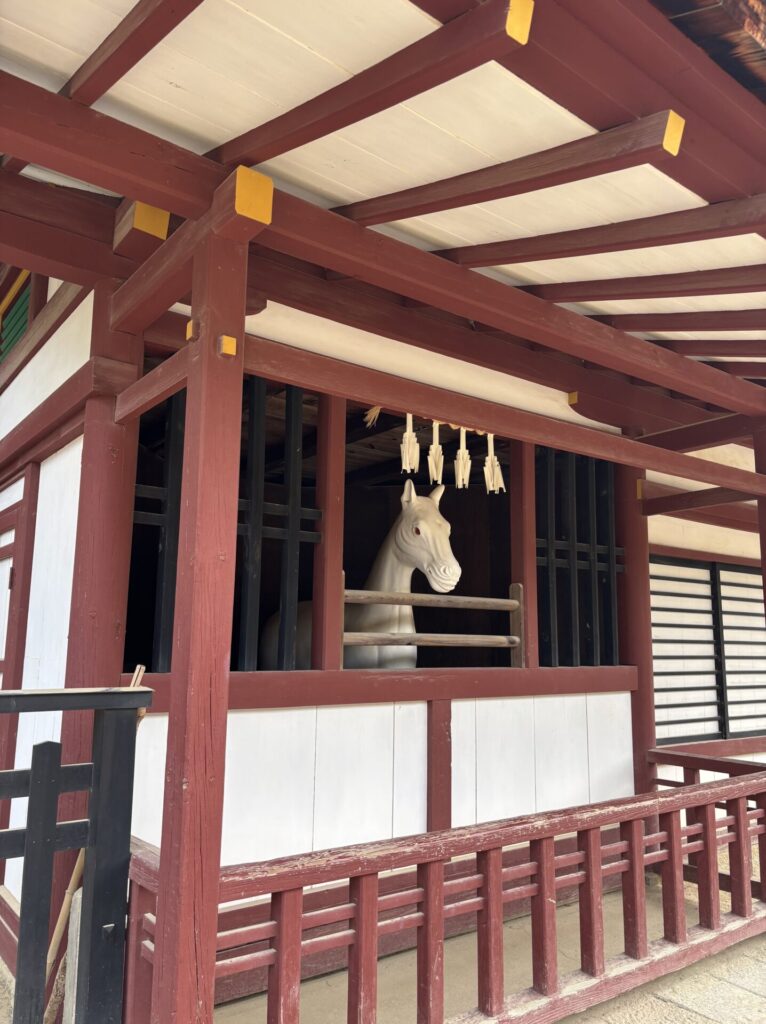
宮島七不思議の一つとも言われる、白い馬。昔は、神様の乗り物として厳島神社に馬が奉納される習慣があったそうです。不思議なことに、奉納された馬は最初は茶色でも、厳島神社で飼われている間にだんだんと白くなったと言われています。昔は本物の白い馬がいましたが、馬の置物になっています。
One of the so-called Seven Wonders of Miyajima is the white horse. In the past, there was a custom of dedicating horses to Itsukushima Shrine as sacred mounts for the gods. According to tradition, even if a horse was brown when it was first offered, it would gradually turn white while being kept at the shrine. In earlier times, there were real white horses, but today they have been replaced by horse statues.
今年の十二支は午(馬)です。十二支とは、中国で時間や方角を表すのに使われ、日本にも伝わりました。12の種類があり、それぞれ12の動物と年が当てはめられ、12年で一周します。日本では明治時代に西洋の太陽暦を使うようになって十二支はほとんど使われなくなりましたが、占いなど縁起を担ぐ場面では今も使われ、新年にその年の動物の物を見ると縁起が良いとされています。いつもは気にしない人も、新年は縁起を担いでその年を表す動物の絵を飾ることもあります。今年は午年、神社や寺では馬の絵が飾られることも多いかと思います。午年は躍動、発展の年と信じられています。
This year’s East Asian zodiac animal is the Horse 馬(Uma午). The East Asian Twelve Zodiac Signs originated in China, where they were used to represent time and directions, and were later introduced to Japan. There are twelve signs, each associated with an animal and a year, completing a cycle every twelve years. In Japan, after the adoption of the Western solar calendar in the Meiji period, the zodiac fell out of everyday use. However, it is still widely used in fortune-telling and in customs meant to bring good luck. It is believed that seeing or displaying the animal of the year at the beginning of the New Year brings good fortune.
Even people who usually do not pay much attention to such beliefs often decorate their homes with images of the zodiac animal during the New Year. As this is the Year of the Horse, images of horses are commonly displayed at shrines and temples. The Horse year is believed to be a time of vitality, movement, and growth.
ちなみに、日本人でも気づいていない人が多いのですが、なぜ12時までを午前、12時を正午、12時以降を午後と呼ぶのかというと、十二支の午が表すのが12時だったからです。
Incidentally, many Japanese people are unaware that the terms a.m.(gozen午前), noon(shogo正午), and p.m(gogo午後) have their roots in the zodiac system. This is because Horse馬 (uma午) in the East Asian Twelve Zodiac Signs corresponds to twelve o’clock, which is why the time before noon is called gozen (before Horse), noon is shōgo (true Horse), and the time after noon is gogo (after Horse).

コメント